|
|
|
Product
Part Number:
|
Product
Description:
|
Tech
Sheet
Number:
|
|
062-0943-001
|
MWR
Sleeve-Valve Cement Retainer, 9.43"OD, 10 3/4" 32.75-60.7#,
Wireline Set
|
062-0943-001
|
|
Click
here for
|
|
|
|
|
|
|
|
|
Features/Description
-
Sets
securely in any hardness casing, including premium grades
- Ratchet lock ring secures
dynamic setting force
- One-piece packing element
and flat metal backup rings which combine for superior seal
- Rated to 5,000 psi at
300 Deg F
- Can be simply converted
to MMR Cement Retainer
- Case-hardened, one piece
slips virtually eliminate premature setting, yet are easily drilled out
-
Locked
together design and extra clearance safely speeds run-in
- Fin bottom to aid in
preventing "Spinning" during drillout
- Can be set directly with
Baker Wireline setting tools
-
Pressure-balanced
sleeve valve is opened and closed from the surface for better control
- Shear studs are Baker style and connect directly to Baker Adjuster Sub
-
Crossovers
are not required
Many of the
outstanding features of our wireline plugs and packers have been incorporated
into the Models 'MMR' and 'MWR' Sleeve Valve Cement Retainers. Both are rugged,
compact units engineered for fast running downhole on either tubing or electric
wireline. Both models feature a positive, pressure-balanced sleeve valve which
is opened or closed simply by lowering or raising the tubing. Positively-secured
packing element and one piece slips combine to resist premature setting due
to well debris or rough handling and assures protection from the hazards of
high-speed running in the well. The metal backup rings prevent extrusion of
the rubber at high pressure and temperature. Because of their design, the metal-to-metal
contact developed by these backup rings is made more secure by pressure increases.
An internal ratchet lock ring retains the dynamic force induced in the retainers
during the setting operation. This simple mechanism assures continued compression
of the packing elements regardless of pressure differentials. Case-hardened,
one piece slips, designed to bite into the hardest casing, are located at each
end of retainer - final assurance of retainer pack-off security. When the need
arises, these slips are easily drilled out.
These Sleeve-Valve
Cement Retainers provide a new horizon in dependability, with the economy of
all of our tools.
Operating
Instructions
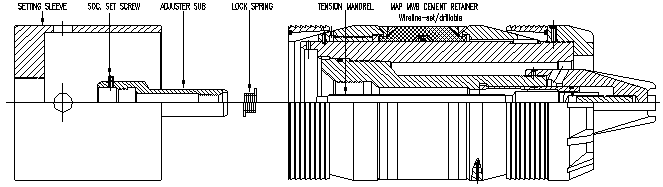
WIRELINE SETTING INSTRUCTIONS
The sleeve-valve
retainers can be set with Baker wireline pressure setting tools. The setting
adapters-contain Baker adapter kits. Kit part numbers are listed in the retainer
specification outline.
An adapter
rod attached to the setting tool and run through the retainer seal bore attaches
to a mild steel release stud located in the shoe at the lower end of the retainer.
A setting sleeve attached to the setting tool pushes against the top slip of
the retainer. During setting, the sleeve holds the retainer outside components
and the rod pulls the retainer central mandrel up; this action sets the slips
and packs off the sealing element. The retainer, thus, is set by compression
(instead of tension on vital components). At a predetermined tension it releases
stud parts and allows the setting tool and adapters to be removed from the well.
To rig the
retainer for running, first screw the adjuster sub to the setting tool and make
wrench tight. Then, tighten tension mandrel on the adjuster sub. Next,attach
the setting sleeve to the setting tool and screw it completely back.
Slide the retainer
(and top slip) over the tension mandrel until the tension mandrel bumps the
top of the shear stud in the retainer. Thread the tension mandrel to the shear
stud by rotating the retainer clockwise (wrench on the valve shoe or shoe of
the retainer). Occasionally, due to rough handling, the collet valve
will shift downward thus not allowing the tension mandrel to reach the shear
stud. Should this happen, first remove the set screw in the valve shoe then
unscrew and remove the valve shoe. Push the collet valve fully upward inside
the retainer body then re-attach the valve shoe and set screw.
The retainer
is run to setting depth in the same manner as a conventional drillable packer
or bridge plug. The packer components are shear pinned as a safety measure against
premature setting caused by well conditions. Line speed should not exceed 200
feet per minute while running. During setting there may be at least one "kicks"
shown on the weight indicator. The kick will indicate the shear stud parting.
After setting the retainer, pick up the setting tool a few feet then set back
down and tag the retainer to assure the retainer is in place.
The MSS Stinger Seal Assembly is used for sealing
into, cementing thru and closing the slide valve on a MWR Cement Retainer when
approximately 3,000 to 5,000 pounds of set down weight is landed on the Cement
Retainer.
Two inches of upward workstring movement at the
Cement Retainer will close the slide valve for fluid containment above or below
the Cement Retainer and will allow tubing testing. Two inches of downward movement
at the Cement Retainer will open the slide valve and allow fluid to be pumped
through the Cement Retainer. Approximately 5,000 to 10,000 pounds tension at
the Cement Retainer is required to snap-out. Each time the seal assembly is
snapped out, the snap-out force is reduced. The snap-out force will stablize
at about 5,000 pounds.Snap in force will stablize at about 2,500 pounds. The
stinger seal assembly can also be released from Cement Retainer by pulling 1,000
pound tension over string weight at the tool and rotating 8 to 10 turns to right.

|
Specifications
|
|
Casing
|
Retainer
OD
|
Setting
Range
|
Seal
Bore
|
Shear
Force
|
Wireline
Setting Kits For Baker 20# Setting Tools
|
Seal
Nipple / Shifter
|
|
OD
|
Wt
(T&C)
|
Min.
|
Max.
|
Part
Number
|
|
10
3/4 "
|
32.75-60.7#
|
9.437
|
9.660
|
10.192
|
2.000
|
50,000#
|
|
|
|
|
Hydraulic
Forces Acting On MWR Cement Retainer
Force created
by applied press to the casing and tubing act upon the stinger sub and tubing
during cementing and pressure testing opreations. These force are variable and
are affected by the area of the cement retainer seal bore, casing and tubing
pressure changes at the Cement Retainer,tubing sze and weight and fluid weight.An
increase in casing pressure at the cement retainer tends to lift tubing which
cansause the slide valve to close. The force generated by a casing pressure
increase is calculated by multiplying the csing pressure increase by outside
area of the tubing minus the seal bore area of the tool.
A pressure
increase in the tubing exerts a listing force at the top of the string which
will reduce the effective hook load. A pressure increase in the tubing at the
Cement Retainer will tend to hold the stinger sub in the tool and keep the slide
valve open. The net of these two forces is upward and is equal to the increase
in tubing pressure multiplied by the area of seal bore in cement retainer. When
this force is equal to the tubing weight, any additional pressure will lift
the tubing and allow the slide valve to close. Therefore, the minimum setting
depth will depend on applied pressure changeds in the tubing and casing acting
to lift the avaliable tubing weight.
The amount
of tubing and annulus pressure that can be applied are limited for any size
and length of tubing. When total of the forces is equal to the weight of the
tubing in fluid, an increase in either tubing or casing pressure will raise
the tubing and close the slide valve. Howeverm the cementing pressure may be
increased if the casing pressure is decrease and vice versa. The sanp latch
feature of the stinger sub has no effect on either opening or closing the slide
valve. The stinger sub will remain in the cement retainer as long as the snap-out
force is not exceeded. If excess tension is pulled on tubing while pressure
testing the snap-out force may be overcome and stinger sub will be pumped out.
How To Use
The Area Pressure Chart:
The values
given in the following chart are shown asarea in square inches affected by pressuer
cahnge and the direction of resulting force. A positive area and a pressure
increase will creat a force tending to keep the slide valve open. A negative
area and a pressure increase will tend to keep the slide valve closed. When
the net force is negative (-), addtional set-down weight must be applied to
keep the slide valve open.
1.Multiply
the Change un tubing pressure at the cement retainer by column 1,4 or 6, whichever
is applicable.
2.multiply
the change in casing pressure at the ceent retainer by column 2,5, or 7, whichever
is applicable.
IF the result
of these two force is tending to close the slide valve (a negative figure),
addtional set-down weight is required to overcome the new upward force.
3.Multiply
the tubing gage pressure by column 3. Thsi area is always negative and tending
to closing the slide vave by li1fing the tubing at the surface.
If by adding
all three forces the result is a negative force tending to close the slide valve
and is great than the total hook load of the tubing, the tubing will raise and
the slide valve will close . Since the hook load is the limited factor, high
pressure at shallow depths may not be possible.
|
AREAS (in sq. ins.) ACTED ON
BY TUBING AND CASING PRESSURES
|
|
Cement
Retainer
Size
|
Tubing
OD
|
Tubing Pressure Greater than Casing
Pressure at the Cement Retainer
|
Tubing
ID
Area
|
Casing Pressure Greater than Tubing
Pressure at the Cement Retainer
|
Casing Pressure Greater than Tubing
Pressure at the Cement Retainer due to Swabbing the Tubing
|
|
Tubing
Area
|
Casing
Area
|
Tubing
Area
|
Casing
Area
|
Tubing
Area
|
Casing
Area
|
|
Column 1
|
Column 2
|
Column 3
|
Column 4
|
Column 5
|
Column6
|
Column 7
|
|
450
to
575
|
1.660
|
+ 0.1
|
- 0.7
|
- 1.5
|
+ 0.1
|
- 0.7
|
- 0.1
|
+ 0.7
|
|
1.900
|
+ 0.6
|
- 1.4
|
- 2.0
|
+ 0.6
|
- 1.4
|
- 0.6
|
+ 1.4
|
|
2.063
|
+ 1.0
|
- 1.9
|
- 2.4
|
+ 1.0
|
- 1.9
|
- 1.0
|
+ 1.9
|
|
2.375
|
+ 1.7
|
- 3.0
|
- 3.1
|
+ 1.7
|
- 3.0
|
- 1.7
|
+ 3.0
|
|
2.875
|
+ 3.3
|
- 5.1
|
- 4.7
|
+ 3.3
|
- 5.1
|
- 3.3
|
+ 5.1
|
|
658
to
2000
|
2.375
|
+ 0.0
|
- 1.3
|
- 3.1
|
+ 0.0
|
- 1.3
|
- 0.0
|
+ 1.3
|
|
2.875
|
+ 1.5
|
- 3.4
|
- 4.7
|
+ 1.5
|
- 3.4
|
- 1.5
|
+ 3.4
|
|
3.500
|
+ 3.9
|
- 6.5
|
- 7.0
|
+ 3.9
|
- 6.5
|
- 3.9
|
+ 6.5
|
|
EXAMPLE
|
| Cement Retainer size |
|
550
|
| Tubing size |
|
2-3/8 Eu 8rd
|
| Maximum hook-load before
latching Snap-Out Seal Assembly into Cement Retainer |
|
7,000 lbs.
|
| Maximum cementing pressure |
|
3,000 psi
|
| Change in tubing pressure
at Cement Retainer (due to heavier fluid introduced during cementing plus
cementing pressure). |
|
3,500 psi
|
| Casing pressure to be applied
during cementing |
|
1,000 psi
|
| 3,500 psi (tubing pressure
change) x + 1.7 (Col. 1) |
=
|
+ 5,950 lbs.
|
| 1,000 psi (casing pressure
change) x - 3.0 (Col. 2) |
=
|
- 3,000 lbs.
|
| 5,950 lbs. - 3,000 lbs.
= + 2,950 (force down) |
|
|
| 3,000 psi (gage pressure)
x - 3.1 (Col. 3) |
=
|
- 9,300 lbs.
|
| + 5,950 - 3,000 - 9,300 |
=
|
- 6,350 lbs.
|
| This is less than the maximum
hook-load of 7,000 lbs. therefore, job may be performed. |
|
|
Suggested
Drilling Technique for Sleeve Valve Retainers
The following
is a general guide for the most successful drill out technique
|
Bit
|
New,
short tooth, medium hard formation
|
|
Rotary
Speed
|
75-125
RPM is recommended.
|
|
Weight
on Bit
|
Apply
5,000 - 7,000# until the top end of the center body of retainer is drilled
away (3 - 5 in for 4-1/2" - 7" tools and 5 - 9 in for 7-5/8"
and larger tools). Additional weight can now be applied across the full
bit diameter. The weight increase is 2,000 - 3,000# per inch of bit diameter
(i.e. 4-3/4" bit use 12,000 - 14,500# weight).
|
|
Drill
Collars
|
8 minimum
for 4-1/2" and 5-1/2" tools
12 or
more for 7" and larger tools for weight.
|
Spudding the
work string and variations in bit speed and bit weight should be made to help
break up debris to re-establish penetration should it cease while drilling.
One or more
junk baskets should be used above the bit when normal circulation is to be used.If
reverse circulation is planned,the casing scraper or other equipment in the
tubing string should have an inside fluid passage as large as the passage through
the bit so cuttings will not bridge.
NOTE:
Drilling times are directly related
to tool size, bit stability, drilling weight, pump rate, bit RPM, type of bit,
drillong fluid, etc. The same considerations should be used when drilling Cement
Retainers as would be used when drilling medium hard formations.