
Part Number:
Number:
Click
here for
|
|
||||
| Product Part Number: |
Product Description: | Tech
Sheet Number: |
||
| 062-0359-005 | Tool,Mechanical Setting,Model MSR,4 1/2"9.5-16.6# | 062-0359-005 | ||
|
Click
here for
|
||||
| Operating Instructions | Assembly Instructions | Parts List/Drawing | ||
| Features/Description | Disassembly Instructions | |||
Model MSR Mechanical Setting Tools are used to mechanically set MMR Sleeve-Valve Cement Retainers. This tool incorporates both a stinger seal and mechanical setting function. In addition, it has a built-in snap-latch, allowing the tool to be latched into the cement retainer with set-down weight and released with either upstrain or right-hand rotation. The sleeve-valve on the cement retainer is in the open position while being run in the well. When the setting procedure is completed, the sleeve-valve may be closed by picking up two inches at the tools or opened by slacking off two inches. The snap-latch feature allows the sleeve valve to be shifted open or closed while the tubing is still anchored to the retainer. The valve is run open so the tubing fill. However,for pressure testing the tubing, the valve can be run closed. Cement Retainers can be set and pressure tested in a single trip.
TUBING SETTING INSTRUCTIONS
MODEL "MSR"MECHANICAL SETTING TOOLS
MODEL "MSB" MECHANICAL SETTING TOOLS
For Tubing-Set Sleeve-Valve Cement Retainers
For Tubing-Set SV Bridge Plugs Cement Retainers
RUNNING INSTRUCTIONS
MAP Sleeve-Valve Cement Retainers can be run and mechanically set with the Model "MSR" Mechanical Setting Tool. This tool incorporates both a stinger seal and mechanical setting function. In addition, it has a built-in snap-latch, allowing the tool to be latched into the cement retainer with set-down weight and released with either upstrain or right-hand rotation. The snap-latch feature allows the sleeve valve to be shifted open or closed while the tubing is still anchored to the retainer. The valve is run open so the tubing may fill. However, for pressure testing the tubing while running, the valve can be run closed.
The Model "MSB" Mechanical Setting Tool, used to set MAP Tubing Set Bridge Plugs, is actually a modified version of the Model "MSR" Mechanical Setting Tool that is used to set MAP Sleeve-Valve Cement Retainers. The shifter sub, seal, and seal sub are removed from the Model "MSR" and a thread protector is attached on the lower mandrel thread. A perforated nipple should be attached at the top coupling to allow the tubing to fill with well fluid while running the tool.
Running-In and Mechanically Setting
The setting tool is designed for use in varied hole conditions and employs several features to prevent premature setting of the retainer or bridge plug or damage to the tool. It is suggested that the tool be run at a moderate speed while avoiding sudden stops. Note: While running in, care must be taken to prevent right-hand rotation from being transmitted to the setting tool. Under no circumstance must there tie allowed more than four turns of the tubing to the right while running in. As a precaution, after every 10 to 15 stands, one left hand turn should be placed in the work string. When the desired setting depth has been reached, the tools should be picked up two (2) feet above the desired setting point. This movement is necessary to provide the required tool stroke to release the upper slips and allow the Control Nut to move freely. Rotate the work string to the right sufficiently to transmit 10 turns to the tool. This right-hand rotation will thread the Control Nut off its matching thread on the Mechanical Setting Tool mandrel and release the Control Sleeve from the running in position. Lower the tools back down to the desired setting depth. The Drag Springs will support the Control Sleeve and Setting Sleeve. The downward motion will push the upper slips from under the Setting Sleeve. The upper slip segments are then forced out against the casing by the leaf springs attached to the inside of each slip segment. When the upper slips are released, the Retaining Sleeve is pulled from over the Dog allowing it to move out and release the Control Latch from the Stinger Sub Body. Refer to the following c\hart and pull tension over pope weight at the tool to set the slips and affect packoff.
|
TENSION REQUIREMENTS
|
||
|
Size tool
|
Min. Tension
|
Max. Tension
|
|
4 1/2-5 3/4"
|
28,000 lb.
|
30,000 lb.
|
|
6 5/8" & Larger
|
45,000 lb.
|
50,000 lb.
|
It is recommended that the maximum tension shown above be pulled when possible. However, to assure sufficient packoff and slip breakage, the minimum tension shown must be pulled. Set down weight equal to the calculated weight required to prevent the slide valve from closing during pumping operations. Do not apply tension after setting weight on retainer other than that required to release setting tool or close valve. Pull a slight strain on work string and pressure the work string to insure that the slide valve is closed.
SPECIAL NOTE: In wells where paraffin or suspended solids in the well fluids are present, the Dog on the Control Latch may not fully release from the Stinger Sub Body. This is indicated when the Cement Retainer sets properly but the slide valve will not close so that the work string can be pressure tested. In this event the work string should be alternately picked up and slacked off. This movement will assist the Dog to move outward on the inclined edges of the locking groove in the Stinger Sub Body,thus freeing the Sub Body for the required two (2) inches of vertical movement.
The Mechanical Setting tool is released from the Cement Retainer of Bridge Plug by pulling 500-1000 lbs. tension at the tool and then rotating the work string 10 turns to the right at the tool. This will shear the rotational lock screw and unscrew the Control Latch from the Cement Retainer or Bridge Plug.
After Releasing from a Cement Retainer
The Mechanical Setting Tool can be reattached to the Cement Retainer by setting down 3,000 to 5,000 lbs. of work string weight and snapped out again by pulling 8,000 to 10,000 lbs. tension at the Cement Retainer. The Stinger Seal will remain in the Cement Retainer until the snap-out retaining force is exceeded. Each time the Mechanical Setting Tool is snapped in and snapped out, the snap-in and snap-out value is reduced until they stabilize at about 2,500 pounds snap-in and 5,000 pounds snap-out. Two (2) inches of upward movement at the Cement Retainer will close the slide valve; two (2) inches of downward movement at the Cement Retainer will open the slide valve.
The sleeve-valve retainers can be set with Baker wireline pressure setting tools. The setting adapters-contain Baker adapter kits. Kit part numbers are listed in the retainer specification outline.
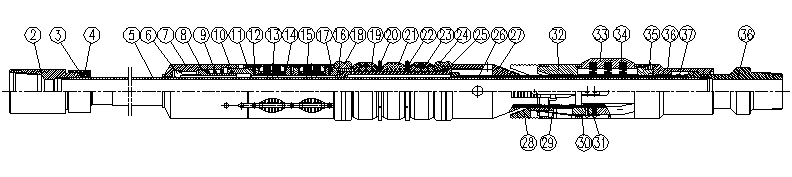
1. Thread Control Nut Clutch (item 16) onto threads on lower end or Mandrel(item 3) until it shoulders out.
2. Thread Control Nut (item 15) onto control threads until clutch surface of Control Nut and Control Nut Clutch engage.
3. Slide Retaining Sleeve (item 17) through Control Sleeve and engage Retaining Sleeve's upper external shoulder with Control Sleeve's lower internal shoulder.
4. Align internal keyway in control Sleeve with key on Control Nut and slide Control Sleeve up over Control Nut and mandrel until Retaining Sleeve's shoulder is against control Nut.
5. Slide Drag Ring (9) and Lower Drag Collar (10) over mandrel.
6. Slide Tru-Arc Retainer (item 7) over the Mandrel and locate into groove.
7. Insert Drag Springs into slots on Lower Drag Collar and slide Drag Ring over Collar Springs.
8. Make-up Lower Drag Collar into Control Sleeve hand tight. Unscrew Lower Drag Collar out until threaded holes for Cap Screws(item 12) can be seen through mating holes in Control Sleeve. Install Cap Screws and tighten. Care should be taken during this procedure to prevent the Control Nut from backing off.
9. Slide Upper Drag Collar (item 4) and Drag Ring onto Mandrel. Inert Drag Springs into slots on Upper Drag Collar and slide Drag Ring over Drag Springs. Align holes and install Cap Screws (item 6).
10. Thread Coupling (item 2) onto Mandrel. Place Coupling in a vise and tighten Mandrel to Coupling connection with a pipe wrench. Place wrench in the under cut wrenching area on Mandrel.
11. Screw Setting Sleeve (item 23) onto Control Sleeve (item 11) until Setting Sleeve upper end contacts the upset on Control Sleeve.
12. Coat Dog Springs (item 22) with grease and insert into appropriate holes in control Latch (item 24). Insert Dog (item 20), Dowel Pins (item 21) and Set Screws (item 19) into Control Latch. Be sure that the Dowel Pings trap the Dog in the Control Latch.
13. Place Key (item 25) into vertical slot on Stinger Sub Body (26). Align keyway in Control Latch with Key and slide Control Latch onto Stinger Sub Body. Install O-ring (item 18) on Stinger Sub Body. Align and depress Dog into locking groove of Stinger Sub Body and make up into the lower end of the Mandrel. The Dog must move under the Retaining Sleeve as the Stinger Sub Body and Mandrel are made up. Make up wrench tight.
14. Insert Oring (item 28) into groove inside of Stinger Seal (item 27). Install Stinger Seal on Stinger Sub Body. Install Slide Valve Stinger (item 29) on Stinger Sub Body. Make up wrench tight.
15. Screw Setting Sleeve (item 23) on control Sleeve and install Set Screws (item 14).
1. Clamp Coupling (item 2) in vise. Loosen and remove Slide Valve Stinger (item 29) from Stinger Sub Body (item 26). Remove Stinger Seal (item 27) and Oring (item 28).
2. Loosen and remove Stinger Sub Body/Control Latch subassembly from the Mandrel (item 3). Remove Oring (item 18) and slide Control Latch (item 24) off Stinger Sub Body.
3. Remove Set Screws (item 12) from Control Latch. Turn Control Latch upside down and depress Dog (item 20) to remove Dowel Pins (item 21). Remove Dog and Springs (item 22).
4. Remove Set Screws (item 14) from Setting Sleeve (item 23) and unscrew Setting Sleeve from Control Sleeve (item 11).
5. Remove Cap Screws (item 6) from Upper Drag Collar (item 4) and slide Drag Ring (item 5) off.
6. Remove Cap Screws (item 12) and unscrew Lower Drag Collar (item 10) from Control Sleeve and remove Control Sleeve. Remove Retaining Sleeve (item 17) from Control Sleeve.
7. Remove Cap Screws (13) from Lower Drag Collar and slide Drag Ring (item 13) off and remove Drag Springs (item 7).
8. Loosen Mandrel to Coupling connection. Place wrench in under cut on Mandrel . Remove Coupling.
9. Remove Upper Drag collar and Upper Drag Ring from Mandrel. Remove Tru-Arc Retainer (item 8).
10. Remove Lower Drag Collar and Drag Ring (item 9) from Mandrel.
11. Remove Control Nut (item 16). Do not remove Control Nut Clutch (item 16) unless required.