| |
Product
Part Number: |
Product
Description: |
Tech
Sheet
Number: |
051-5482-101 |
WSRA
Sleeve-Valve Cement Retainer, 4.24"OD, 5-1/2"13.0-25.0#,
5-3/4"22.5-25.2#, Wireline Set |
051-5482-101 |
| Click
here for |
|
|
|
|
|
|
Features/Description
-
Sets
securely in P-110 casing
-
Ratchet
lock ring secures dynamic setting force
-
Model
'A' features three-piece packing element and rocker-action metal backup
rings which combine for superior seal. Rated to 10,000 psi at 300 Deg F
-
Model
'E' one piece packing element provides economical performance at 7,500 psi
and 200 Deg F
-
Case-hardened,
one piece slips virtually eliminate premature setting, yet are easily drilled
out
-
Keyed
lower cone reduces drill out time
-
Pressure-balanced
sleeve valve is opened and closed from the surface for better control
-
Both
models easily converted to SV bridge plugs
-
Both
models easily converted for mechanical or wireline setting
Many of the
outstanding features of our wireline plugs and packers have been incorporated
into the Models 'A' and 'E' Sleeve Valve Cement Retainers. Both are rugged,
compact units engineered for fast running downhole on either tubing or electric
wireline. Both models feature a positive, pressure-balanced sleeve valve which
is opened or closed simply by lowering or raising the tubing. Positively-secured
packing elements and one piece slips combine to resist premature setting due
to well debris or rough handling and assures protection from the hazards of
high-speed running in the well. The Model 'A's three-piece, multi-hardness rubber
packing elements provide a highly dependable pack-off system. The metal backup
rings prevent extrusion of the rubber at high pressures and temperatures. Because
of their design, the metal-to-metal contact developed by these backup rings
is made more secure by pressure increases. An internal ratchet lock ring retains
the dynamic force induced in the retainers during the setting operation. This
simple mechanism assures continued compression of the packing elements regardless
of pressure differentials. Case-hardened, one piece slips, designed to bite
into the hardest casing, are located at each end of retainer - final assurance
of retainer pack-off security. When the need arises, these slips are easily
drilled out. The Model 'E' Cement Retainer differs only in the lower cost, lower
rated pack-off system. Slightly faster drill out is an added benefit of the
Model 'E'.
These Sleeve-Valve
Cement Retainers provide a new horizon in dependability, with the economy of
all of our tools.
Operating
Instructions
WIRELINE SETTING
INSTRUCTIONS
The sleeve-valve
retainers can be set with either MAP, Gearhart, or Baker wireline pressure setting
tools. The setting adapters-contain MAP (and Gearhart) thread connections thus
Baker adapter kits are required if a Baker tool is used. The kit converts the
lower end of the Baker tool to MAP connections. Kit part numbers are listed
in the retainer specification outline.
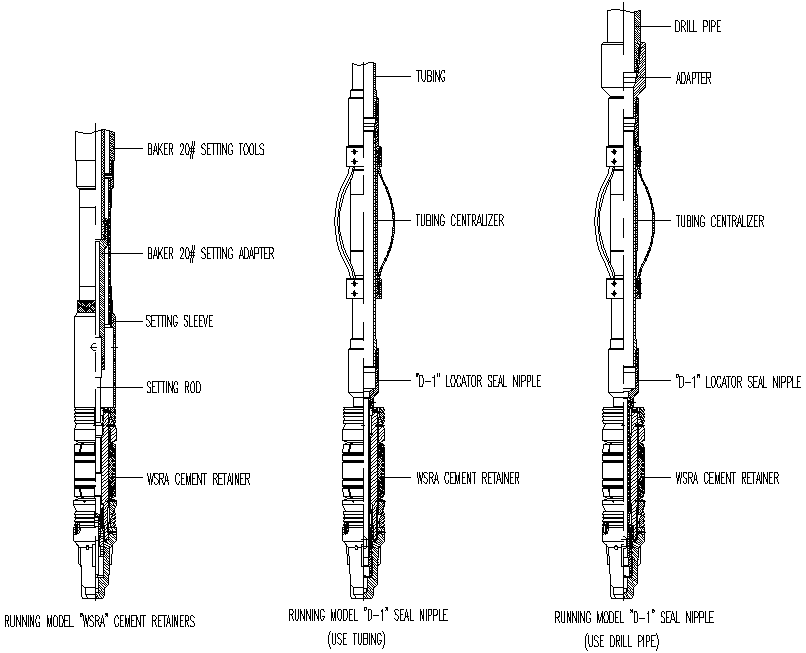
An adapter rod attached to the setting tool and
run through the retainer seal bore attaches to a mild steel release stud located
in the shoe at the lower end of the retainer. A setting sleeve attached to the
setting tool pushes against the top slip of the retainer. During setting, the
sleeve holds the retainer outside components and the rod pulls the retainer
central mandrel up; this action sets the slips and packs off the sealing element.
The retainer, thus, is set by compression (instead of tension on vital components).
At a predetermined tension the release stud parts and allows the setting tool
and adapters to be removed from the well.
To rig the retainer for running, first screw the
adapter rod to the setting tool and make wrench tight. Tighten the lock nut
on the adapter rod against the setting tool bottom piston. Next, attach the
setting sleeve to the setting tool and screw it completely back.
Slide the retainer
(and top slip) over the adapter rod until the rod bumps the top of the release
stud in the retainer. Thread the rod to the stud by rotating the retainer clockwise
(wrench on the valve shoe of the retainer). Occasionally, due to rough
handling, the collet valve will shift downward thus not allowing the adapter
rod to reach the release stud. Should this happen, first remove the set screw
in the valve shoe then unscrew and remove the valve shoe. Push the collet valve
fully upward inside the retainer body then re-attach the valve shoe and setscrew.
The setting sleeve is
now advanced down to the top slip on the retainer. This slip will be butting
against two shear pins protruding from the upper cone. These pins are placed
in the cone to stop the upper slip from expanding too far when the setting sleeve
is screwed down against the slip. When the setting sleeve is felt to torque
up, it has been screwed down the necessary distance. Finally, advance the setting
sleeve lock ring down against the setting sleeve and make-up tight.
Suggested
Drilling Technique for Sleeve Valve Retainers
The following
is a general guide for the most successful drill out technique
Bit |
New,
medium tooth, hard formation |
Rotary
Speed |
80
RPM normal (120 RPM as req'd) |
Weight
on Bit |
Apply
5,000 - 7,000# until the top end of the center body of retainer is drilled
away (3 - 5 in for 4-1/2" - 7" tools and 5 - 9 in for 7-5/8"
and larger tools). Additional weight can now be applied across the full
bit diameter. The weight increase is 2,000 - 3,000# per inch of bit diameter
(i.e. 4-1/2" bit use 9,000 - 13,500# weight). |
Drill
Collars |
8 minimum
for 4-1/2" and 5-1/2" tools
12 or
more for 7" and larger tools for weight. |
Spudding the
work string and variations in rotary speed and set down weight should be used
to aid in breaking up large metal parts and preventing bit "tracking".
One or more
junk baskets should be used above the bit when normal circulation is employed.
NOTE:
Should the retainer need to be mechanically
set with the Model "A-1" Mechanical Setting Tool, it will be necessary
to convert the retainer by replacing the wireline top slip with a segmented
mechanical slip. The two protruding shear pins in the upper cone must be removed
by breaking the pins flush at the surface of the cone and then filing smooth.
Also, the release stud in the sleeve valve of the retainer must be removed or
cementing flow volumes will be drastically reduced from the blocked stinger
sub I.D. flow passage. The release stud is removed by first removing the setscrew
in the valve shoe then removing the valve shoe. The release stud is screwed
inside the valve shoe and can be removed by gripping with vise grips and unscrewing
out If this method fails saw a screwdriver slot in the top of the release stud
with a hacksaw to permit the use of a screwdriver or chisel to remove the stud.
The retainer
is run to setting depth in the same manner as a conventional drillable packer
or bridge plug. The packer components are shear pinned as a safety measure against
premature setting caused by well conditions. Line speed should not exceed 200
feet per minute while running. During setting there may be at least two "kicks"
shown on the weight indicator. One kick will indicate shear pins shearing and
the last kick will indicate the release stud parting. After setting the retainer,
pick up the setting tool a few feet then set back down and tag the retainer
to assure the retainer is in place.
Specifications |
Casing |
Retainer
OD |
Setting
Range |
Seal
Bore |
Shear
Stud |
Seal
Nipple / Shifter |
OD |
Wt
(T&C) |
Min |
Max |
Part
Number |
5-1/2
5-3/4 |
13.0-25.0#
22.5-25.2# |
4.24 |
4.580 |
5.047 |
1.345 |
30,000# |
|
|
|
Wireline
Setting Equipment |
Adapter
Rod |
Setting
Sleeve |
Wireline
Setting Tool |
MAP
/ GO / Gearhart |
Baker |
Baker
to MAP Adapter Kit |
|
|
3-1/2"OD
Tool |
No.
20 |
|
For
Tubing Set See 051-5482-102 |
